

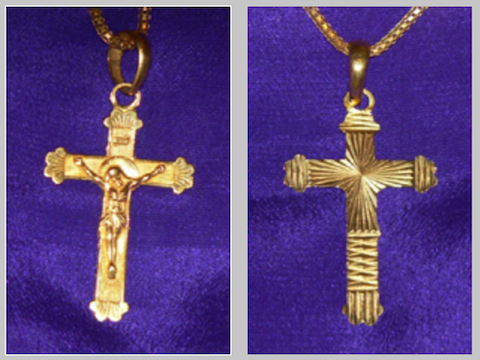
BE A GOOD CHRISTIAN… A TRUE CHRISTIAN… A BETTER CHRISTIAN
Lessons from Sai • April 1, 2006 • 64 min read
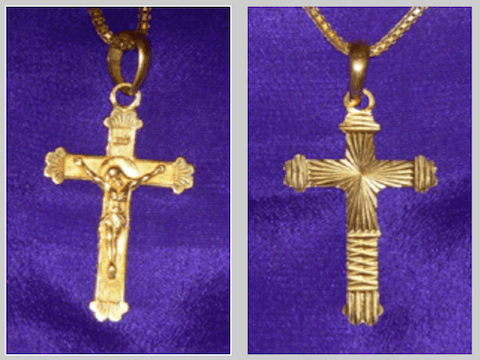
This is the season in which Christians celebrate Easter – Jesus’ resurrection from the dead after his crucifixion. What is the significance of this celebration, not only for Christians but for all people everywhere? How have the teachings of Sathya Sai Baba illuminated the meaning of Jesus’ life, death, and resurrection in the lives of Christians who have come to know him? These two questions have prompted this cover story.
This is the season in which Christians celebrate Easter – Jesus’ resurrection from the dead after his crucifixion. What is the significance of this celebration, not only for Christians but for all people everywhere? How have the teachings of Sathya Sai Baba illuminated the meaning of Jesus’ life, death, and resurrection in the lives of Christians who have come to know him? These two questions have prompted this cover story.
To fully appreciate the story of Easter, we must start with the fact that Jesus was born into the culture and religion of the Jewish people over 2,000 years ago. According to the first book in the Jewish Holy Scriptures, humanity was originally created by God in a state of purity and blissful intimacy with God:
Then God said, “Let us make man in our image, in our likeness…” So God created man in his own image… male and female He created them. God blessed them and said to them, “Be fruitful and increase in number… I give you every seed-bearing plant on the face of the whole earth and every tree that has fruit with seed in it. They will be yours for food…” God saw all that He had made, and it was very good . (Genesis 1:26-30)
|
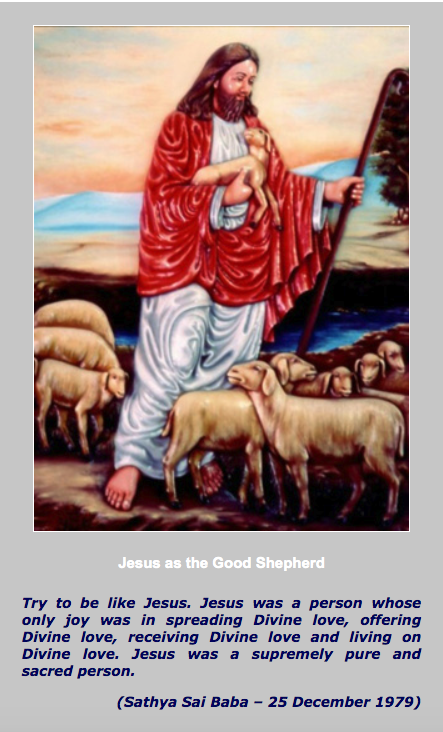
Jesus gave spiritual teachings and performed many miraculous healings for the people of his time, as Sathya Sai Baba relates:
Jesus taught simple, practical lessons in spiritual advancement for the good of mankind. He manifested Divine powers to instil faith in the validity of his teachings. He marked out the path that can confer on man the sweet nectar of Divine bliss (ananda). He exhorted people by precept and example to cultivate the virtues of charity, compassion, forbearance, love and faith. These are not separate and distinct qualities; they are only the many facets of the Divine in man, which he has to recognise and develop. (24 December 1972)
In the course of his ministry and miracles, even raising people from the dead, certain religious and political leaders felt challenged and threatened by Jesus’ popularity. Sai Baba tells us:
Jesus was the epitome of compassion and the refuge of the poor, needy and forlorn. But, many people tried to create troubles for Jesus, since they did not like his sacred teachings and activities. Their hatred for Jesus increased day by day. Even the priests turned against Jesus as they became jealous of his growing popularity. Many people out of jealousy laid obstacles in his path and even tried to kill him. (25 December 2000)
Jesus foretold what was to happen to him – that he would be crucified and then rise from the dead on the third day. After three years of ministry, Jesus was going to Jerusalem for an upcoming Jewish holy festival, the Passover Feast, and a great crowd heard that he was coming:
They took palm branches and went out to meet him shouting, “Blessed is he who comes in the name of the Lord!”(John 12:13)
|
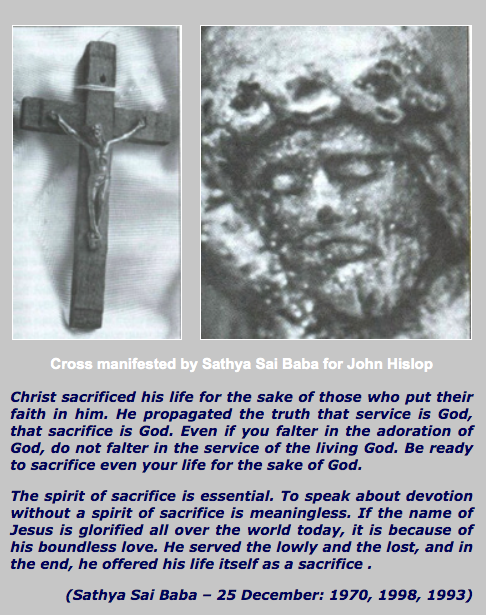
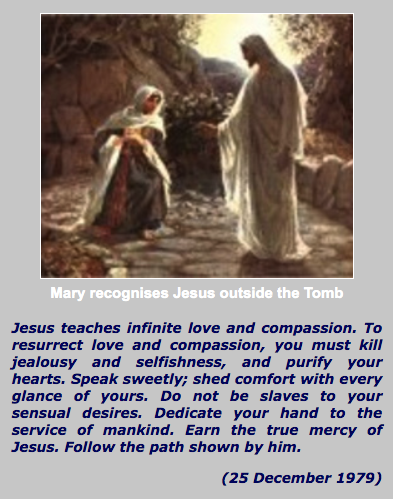
On the next afternoon, which was a Friday, Jesus was put to death by hanging on a cross. (In the centuries to follow, Christians called this day Good Friday.) Yet, he forgave all, even those who were nailing him to the cross. As Sathya Sai Baba elaborates:
Jesus wished well for those who insulted and injured him. He knew that God wills all. So, even on the cross he bore no ill-will towards any one and he exhorted those with him to treat all as instruments of God’s Will. (25 December 1982)
|

WHAT IS THE SIGNIFICANCE OF JESUS’ RESURRECTION FOR CHRISTIANS
AND FOR THOSE OF OTHER FAITHS?
For a Christian, the resurrection of Jesus is essential to knowing that Jesus was Divine and that his teachings were Divine. St. Paul – whom Sai Baba said “was originally an inveterate critic of Jesus, (but) was transformed by Christ’s love into the greatest apostle of Jesus and the first propagator of the Christian faith” – stated the importance of Jesus’ resurrection to Christians in a letter to an early Christian community:
If Christ had not been raised from the dead, our preaching is useless and so is your faith… (and) you are still in your sins. But Christ has indeed been raised from the dead. (1 Corinthians 15:15, 17, 20)
Sathya Sai Baba gives a poignant understanding of the significance of this “resurrection” and the lessons we can all learn from it, no matter what our religion:
What is the resurrection, really? It is the revelation of the divinity inherent in man. That is the result of contact with the Godhead; that can come only after years of contrition. Man is led into the wrong belief that the accumulation of material possessions will endow him with joy and calm. But Divine Love (Prema) alone can give that everlasting joy. Divine Love alone will remove anger and envy and hatred. ( 28 February 1964 )
Jesus’ physical resurrection points back to the early days of Jesus’ ministry when he spoke of our need to be resurrected and reborn in a different way – in the knowledge and direct experience of God:
I tell you the truth, no one can see the kingdom of God unless he is born again. Flesh gives birth to flesh, but the Spirit gives birth to spirit. (Jesus – John 3: 3, 6)
It is this same “rebirth of spirit” that many Christians have experienced as a result of coming to know Sathya Sai Baba. In fact, this rebirth of spirit has been experienced by followers of all faiths as they have responded to Sathya Sai Baba’s consistent urging that each of us should deepen our faith and sincerely practise our chosen religion or spiritual path:
|
“Be a good Christian. Be a true Christian. Be a better Christian.” What does that really mean in light of celebrating the resurrection of Jesus from the dead after his crucifixion? Many people who were brought up in the Christian religion have experienced a time when their beliefs faded in importance in their lives, or they doubted and questioned what they were taught in childhood. Many have felt a need to search for a deeper understanding of what Jesus taught and how it applies to their lives today.
We have collected stories of seven men and women from Christian backgrounds throughout the world, showing us how their knowledge and love of Jesus Christ has been resurrected, reborn, or renewed through their association with Sathya Sai Baba. They share with us how they have discovered a closer relationship with Jesus, a more profound appreciation of who Jesus was, and a deeper practice of what Jesus taught. Each story brings to life teachings of Jesus that can apply to us all, no matter what our faith might be.
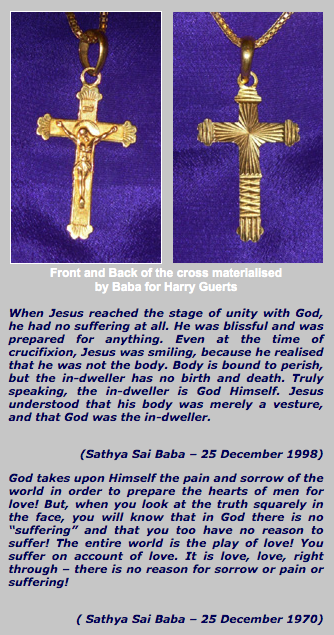
Our first story is from Harry Geurts, guest faculty member of Western music in the Sri Sathya Sai Institute of Higher Learning since 1996, and previously Vice President of the Sathya Sai Organisation in the Netherlands. Growing up immersed in an atmosphere of Christian service, the personal pain he experienced while contemplating Christ’s suffering on the cross often overshadowed his celebration of Christ’s resurrection, until he gained a profound insight from Sathya Sai Baba.
IN GOD THERE IS NO SUFFERING
Harry Geurts – The Netherlands
|
|
I concluded my short speech with a question to Swami, “Please Swami tell us more about the life of Jesus.” I wasn’t expecting that he would stand up and give a discourse, but I wanted to know more.
|
Just as Divine love brings about the experience of oneness with God, it also awakens the awareness of the Divinity in one and all. This was the discovery of Bernice Mead, National Coordinator of the “Education in Human Values” programme in the USA. During her interview with Dr. Venkataraman of Radio Sai, she tells us how, through Sathya Sai Baba’s presence in her life, she transformed her fundamentalist Christian background into a broad understanding that we are all Divine.
YOU ARE GOD, ALL ARE GOD
Bernice Mead – USA
I found out about Swami in 1977 and made my first pilgrimage in 1978. I am a very atypical devotee because I come from a large farm family in mid-America with 11 children and was raised as a fundamentalist Christian. When I met my husband he wasn’t interested in organised religion and so we began to search for truth. We first went to more liberated Christian churches but could not find what we were looking for there. So we started taking meditation classes.
I had been taught all my life that Jesus was the only way. And not only was Jesus the only way, but the church that I attended was the only church. I questioned this from the time I was a teenager. It seemed unreal to me that everyone who loved God could not have a chance to be with God. So I wanted to know the truth and what this was all about. Could it possibly be that the little fundamentalist church I was going to was the truth, the only truth?
I had just had my first child and I was going through post-partum depression, so I was really searching for something besides what I had. Eventually, I heard about a meeting to be held by a man who had been to Sai Baba and who was going to tell about his experiences.
I went because my husband wanted to go, but I didn’t think that I would hear anything of relevance. We were both captivated by his stories, which were only telling about his experiences. We spent the whole evening there. We smelled a sweet jasmine right away; we thought it must have been incense, but it wasn’t. When we left that evening around 11pm, we felt excited and took three books with us. One of them was the “Holy Man and the Psychiatrist” by Samuel Sandweiss.
I read the book and right away I wanted to come to India. I felt so drawn and so much in love with Sai Baba. I wanted to know who he was and whether he was for real. Even though I am still mystified by him, I love him dearly.
Back in 1978, coming to the ashram was very difficult. The weather was hot and humid, the food was bothering me, and there were 14 of us in the flat that I stayed in. I still had a lot of doubts and there was a time when I wasn’t sure if I was in the right place.
Swami called all of the Westerners into the mandir and gave us a discourse. Then he came around and gave each of us little packets of vibhuti. I said to him, “Thank you.” That afternoon I wrote him a letter and went early to darshan so I could get the first row. He came and took my letter and said, “Thank you” to me. So my first words to him were thank you and his first words to me were thank you in return. This made me very happy.
During my second trip in 1979, I had to go alone after all of my friends had come home. One morning while sitting under his window where he lived in the mandir at the time, I had this thought, “What if he isn’t who he says he is? What if he is the anti-Christ?” I didn’t know where these thoughts were coming from because I had been so happy and so thrilled at being there.
I got up and went back to my room where I wept and wept. While I was there I prayed very hard, I prayed to this God that I had prayed to all my life, somewhere out there in space. I decided that I should also pray to Jesus and so I brought Jesus into the prayer also. When I went to darshan, Swami called me for an interview, which was a fulfilment of my dream. He talked to me about all of the doubts I had had in my mind that morning.
There was a part of me that knew that he knew all that I was experiencing – but to experience that was another thing. He said to me, “I hear all of the prayers, I even hear the prayers to Jesus.” So I knew that he was telling me that he had been with me that morning and knew that I had prayed to Jesus. Then he made me candy. My earthly father owned a grocery store and used to bring me candy when I was a child. This was like my earthly father giving me something so I would feel better. I had been crying all morning, and I was like a child at his feet, so captivated and so much in love.
The one lesson of Swami’s that I find most important is that we are God, we are all God. Elsie Cowan was a very good friend of mine and she used to say all the time, “You are God. You are God. You are no different than God.” And God is love, so love and God are synonymous. To me this is the richest and the best teaching.
I have had wonderful experiences with children where I have learned the lesson that we are all God. When I taught kindergarten with six-year-old children we would have a few minutes each day of quiet time.
One day a sweet little boy wanted to share what he had experienced that day during the quiet time. He said, “I saw God.” I asked him if he could tell us what God looked like and he said, “Yes, yes” and he put his hands over his head and said, “He had a lot of black hair and a blue business suit.”
One day while I was walking in a park, a little five-year-old came up to me on his bicycle and said, “Please go home with me. I want you to meet my parents.” He kept asking me to go home with him so I could meet his parents.
I didn’t know this boy, he just came out of the blue while I was on my afternoon walk. I told him, “I can’t go home with you today, but I’ll come this way tomorrow and I promise I’ll go home with you tomorrow.”
But he kept begging me, “Please, oh please.” He was such a cute little mischievous kid, so I said to him, “Say, do you know Baba?” I don’t even know why I said this; it was out of the blue. He jumped off of his bicycle and said, “Yes, I do! He’s Jesus Christ and all his angels!” He got back on his bicycle and rode off and I never saw him again.
I am the national coordinator of the EHV programme in the USA , and I travel through the states giving teacher training classes.
In 1979 I started one of the first Bal Vikas children’s classes in southern California. We would sing a lot of songs and began to learn bhajans.
We all learned and grew together. One time I had a little boy who was quite precocious and he gave his school teachers difficulty in the classroom. After he had attended Bal Vikas for a year, his school teacher told me, “I don’t know what you’re doing, but whatever you are doing, keep it up. I have seen such a wonderful change in this child this year.”
These are the kinds of experiences I have had with children. God has had wonderful fun with me through children.
Through children, God revealed to Bernice many new insights about the nature of God. But William Miller – guest faculty member in the Sri Sathya Sai Institute of Higher Learning’s MBA programme since 1999, and co-author of Human Values at Work – had to transcend some deeply in-grained childhood beliefs in order to “see the Light” and “be the Light.”
I AM IN THE LIGHT, THE LIGHT IS IN ME, I AND THE LIGHT ARE ONE
William Miller – USA
As I look back on my upbringing, I was “very Roman Catholic” – even co-president of my parish’s teen youth organisation when I was 17.
I was disciplined and respectful in my relations with girls and elders – wanting to be known as a good person, and to me the ten commandments were the perfect “measuring stick” to determine if I was being good. I particularly strived to be a peaceful person, not ever wanting to hurt anyone.
But this determination did not come from a positive love for God and others; rather it was based in a self-dislike and self-criticism which I wanted to overcome.
My experience of life and being a Christian was coloured by a strong belief that my nature, particularly as a male, was “selfish, hedonistic, and environmentally destructive” – and that my job as a Christian was to overcome my nature. God was “out there” or “up there” – distant, judging, punishing, loving you only if you were good.
After going to college in the mid 1960’s, I found myself becoming “agnostic”, neither believing nor disbelieving in God. I just didn’t know. While I enjoyed being with friends and the priest at my university’s Catholic centre, I fell away from the Catholic religion.
I felt attracted to Zen Buddhism as a practical “substitute” to nurture my inner growth, particularly as author Alan Watts introduced it to the West. In fact, it was his book “Myth and Ritual in Christianity” that first renewed my appreciation for the spirit of Jesus’ teachings. In 1982, a deeper level of spirituality began to stir within me.
I found myself saying the word “Divine” without consciously thinking about it ahead of time. A new joy began to well up inside of me and I would make up little songs such as “Divine love, expressing through me, always draws to me all that I need.”
The night just before Easter Sunday that year, I “accidentally” (are there any coincidences or accidents?) came across a film on TV called “The Lost Years of Jesus”, produced by Richard Bock.
I watched the entire film, but when near the end it showed this Indian guru named Sathya Sai Baba, I paid little attention. Only later did I realise that Easter weekend was my first semi-aware contact with Baba.
Later that year, a good friend was reading “Man of Miracles” by Howard Murphet, chronicling many early experiences with Sai Baba. I had never ever sought an India spiritual teacher, but I asked to borrow the book.
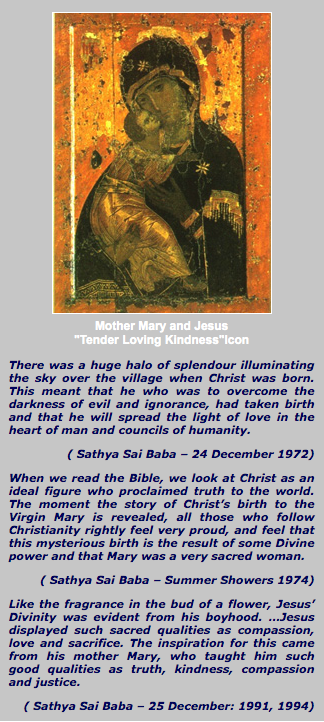
Halfway through reading it, I thought, “This is very, very difficult to believe, that such a person is walking the earth – but if it’s true, I don’t want to look back in 40 years and say that I missed my chance!” I knew inside that I should go see for myself, and I travelled to India seven weeks later.
My first day at Prasanthi Nilayam was the last day of a ten-day festival called Dasara. At one point during the morning function, Sai Baba went around and sprinkled everyone with blessed, holy water. I thought, “As a Catholic, this is very familiar” and I felt more at home. Then he gave a discourse.
I could understand very little of the translation into English, given the interpreter's different accent, but a few words rang crystal clear – they were the words I most needed to hear: “When you realise that God is inside you, then the more you go into yourself, the closer to God you become… and the distance between your will and God’s Will likewise begins to diminish.”
When the discourse was over, I walked out of the auditorium stunned and dizzy – I actually had to lean against a tree. While I had been slowly rooting out of my psyche the childhood belief that God was distant and my very nature was sinful, Sai Baba’s words were like the hammer blow that finally split the rock. I had been opened up, healed, and reborn onto a spiritual path that ultimately led me back to a new relationship with Jesus and Christianity.
Ever since I was a 13-year-old attending the Catholic Jesuit High School, I participated once a year in some kind of spiritual retreat. In college and afterwards, these retreats took the form of “human potential” seminars. Now, I made India my annual retreat. I could tell right away that being around Sathya Sai Baba would be the most nourishing way I could find to grow spiritually.
Each year when I would come for 10 to 14 days, on my annual work vacation, I would select a book to bring as my core spiritual reading. In the mid-1980’s, I read the books of two 16th century Spanish Christian mystics: St. Teresa of Avila and St. John of the Cross. Both spoke about the “marriage” of the soul with God, and that the fundamental message of Jesus was the path of Divine love.
The hours waiting for Sai Baba to emerge from his residence to give Darshan were often exquisite times for me to ponder and pursue a new understanding of who Jesus was – through the experience of these two saints who devoted their entire lives to love and know Jesus, and to follow the path he laid down for us.
Sai Baba often spoke of three stages of spiritual growth: “I am in the Light,” “The Light is in Me,” and “I and the Light are One.” St. John of the Cross spoke of spiritual growth in terms of putting a log on a fire: at first, the fire has to heat up the log; then the log begins to emit flames, but only with the helpful heat of the coals; finally, the log is fully ablaze so that there is no distinguishing the “log” from the rest of the fire. I saw that Sai Baba and St. John of the Cross were describing the same three stages. And when Sai Baba explained how Jesus’ life showed us these same stages – as “Messenger of God,” “Son of God,” and “I and the Father are One” – my faith grew that Jesus really could be a model to inspire and guide my spiritual growth.
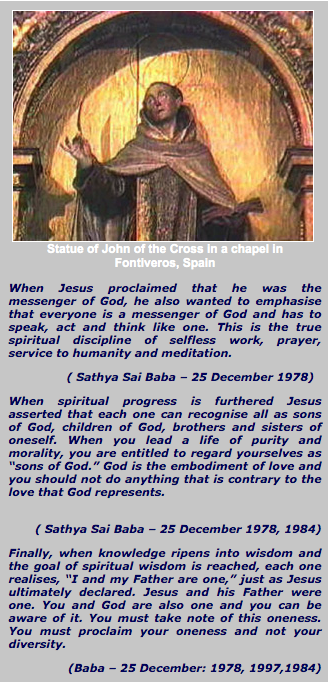
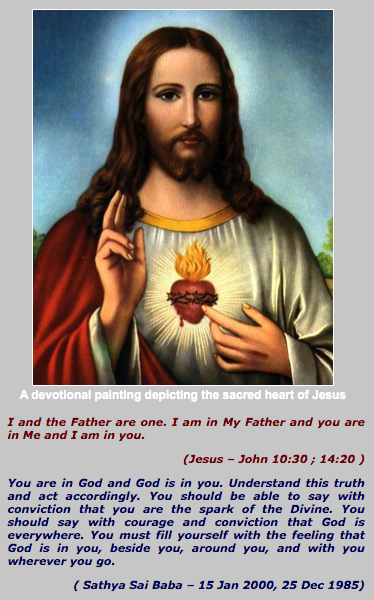
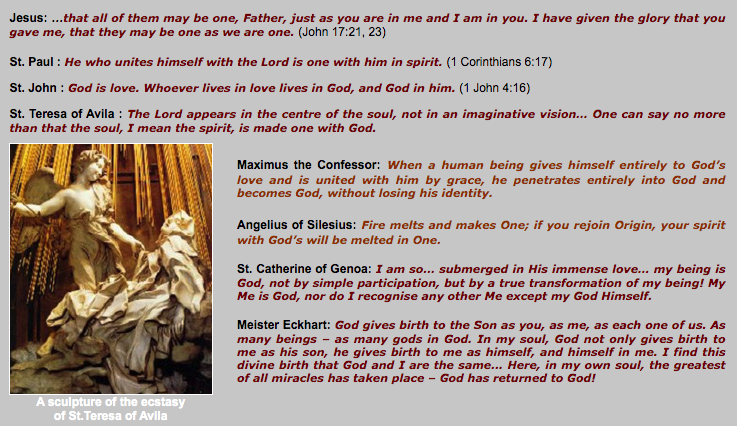
Later, when I read, as if for the first time, Jesus saying, “I am in the Father and you are in Me and I am in You,” I directly experienced that I could travel the pathway with Jesus through these stages, ultimately ending with knowing our union with God. Thus, for me, Jesus’ life and teachings, and the life and teachings of Sai Baba, became mirror reflections of each other. And when I read Jesus’ words about a baptism by fire – “I have come to cast fire upon the earth, and how I wish that it were already kindled! I have a baptism with which to be baptised, and how greatly and sorely I am urged on until it is accomplished!”— I could rejoice, rather than be afraid, that this baptism of fire would ultimately turn this William-log into a heart ablaze with Divine love.
However, the idea that this journey could end with the experience that “God and I are one” – was quite difficult for me to “warm up to.” My upbringing said that this was blasphemy, the statement of an ego-out-of-control. But then, Sai Baba led me back to my Christian tradition where “union with God” was the ultimate aim of every mystic.
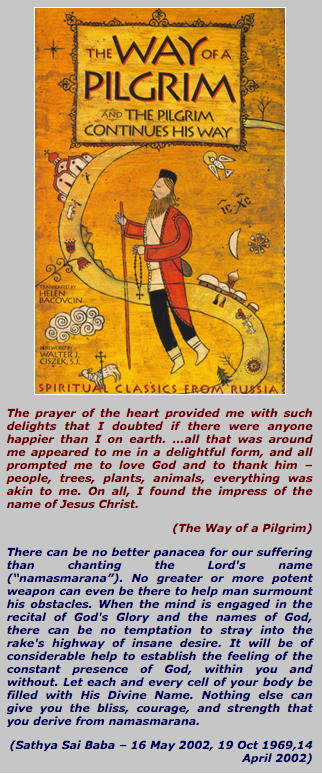
I also began to see how other teachings of Sai Baba were alive and well in the Christian tradition. For example, he has often said that the most effective means of spiritual growth is repetition or singing of the names of God, thus promoting a continuous awareness of God’s presence.
When I read the book, “Way of a Pilgrim” – written in the late 1800’s by a Russian who constantly recited the “Jesus Prayer” (“Lord Jesus Christ, have mercy on me”) – I could only smile in recognition of what Sai Baba’s advice could mean for a Christian.
Yet all of this has been just the beginning. My journey with Sai Baba and Jesus, which started (at least in my own awareness) one Easter weekend in 1982, continues forward – my own version of what it means to experience “heaven on earth.”
Just as William had to overcome early childhood beliefs, in order to love Jesus and himself, Sylvia Alden – choir director for the Prasanthi Christmas adult choir – struggled with beliefs about Jesus that she was taught as a child. She had a healing experience of Divine Love in the presence of Sathya Sai Baba that helped her understand how she could live a Christ-like life.
GOD IS PURE LOVE
Sylvia Alden – USA
I was brought up on a farm in the mid-western part of the United States during the time after the Great Depression and that which preceded the Second World War. Many were struggling to recover from the depression and the fear of the war was strong in our rural community.
My maternal grandparents became born-again Christians and my paternal grandfather was a Congregational minister. Their concept of Jesus, and by extension of God, was of Divine beings one could never expect to please. One could only fear and obey. Love was not emphasised.
As a child, these grandparents and their religious beliefs had a marked and indelible impression on me. My parents also followed these teachings and I wanted very much to please them all. Somehow, I always fell short of the mark.
Jesus became someone who knew everything I did and was marking it down so that come the Day of Judgment, he could tell God all the bad things I had done.
As I was not the most perfectly behaved child, Jesus had a lot on his list. He became someone to fear and dislike. I wondered how Jesus could be so wonderful if he would tell on a little kid.
As part of the religious training that was given to me by my parents and grandparents, I was taught that unless one became a born-again Christian one would be condemned to hell’s fire and damnation for all of eternity. There was no other choice.
It was extremely confusing to me that the same Jesus who was held up to love people so much that he was willing to be crucified would also condemn those who had never even heard his name. As I reached my teenage years, I struggled to put these teachings into some semblance of logic that I could fully accept. I went to church, sang in the choir, read my Bible, and acted “as if” I truly believed the sermons I heard. The one positive was the music.
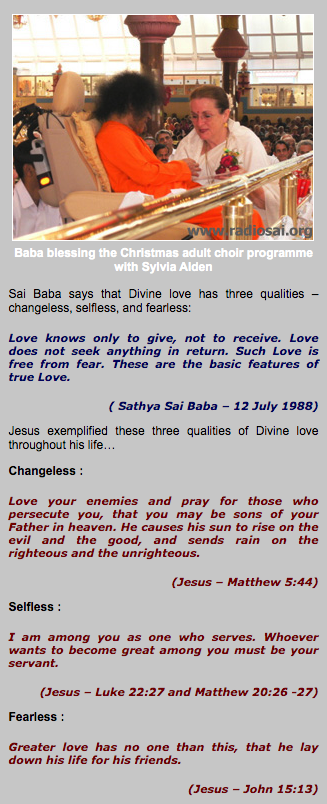
I loved the hymns that spoke of the love and glory of God. I drew comfort from the music. I convinced others that I was a good Christian. I felt like a hypocrite because my actions were lip service only.
My actions were just for show. I still could not accept the idea that a person who loved Buddha or some other form of God would be headed for hell.
When I married and had children, I was firm in the conviction that my children would not grow up in fear of God. I wanted them to be free of the judgment of the beliefs of others. I doubted that if God/Jesus existed, they really cared what we did. Why else would babies die, people fight in wars, and good people suffer?
As much as I attempted to push God to the back of the closet, He refused to stay there. He showed Himself to me in music and nature.
I loved nature in all its many forms and music was my healing place. The yearning for the Supreme Being that created this beautiful universe and populated it with people of such diversity and beauty grew.
I was searching for what would ring as truth within my heart, a truth that I could share with my children which would allow them to love others irrespective of their religious convictions.
I began to study Eastern religions, starting with the teachings of Aurobindo. His teachings touched a place within that caused the door of my heart to crack open a bit.
I first heard of Sri Sathya Sai Baba in 1972. “Nice,” I thought. “There is another saint like Aurobindo.” I continued to read and study the wisdom of many Indian saints. Peace was growing in my heart. I studied meditation and even had the temerity to teach meditation classes.
In 1978, I made my first journey to the Beloved Divine Feet of Swami. He looked at me and I knew that He knew everything I had ever said or done, would ever say or do.
And miracle of all miracles, He loved me. He was all that I had ever thought God should or could be – love, pure love. There would never be condemnation or exclusion from Him.
My heart was full to overflowing. God was here on this earth and I had seen Him, talked with Him, felt His touch and I was free from fear and doubt. Joy is too small of a word or concept to express my feelings. I was truly home.
Swami’s teachings are universal. They allowed me to look more objectively at the teachings of the Christian religion. His discourses on the life of Jesus brought the real Jesus to life for me. I could now read the Bible with an openness that was lacking before.
The actual sayings of Jesus reflected Swami’s words. I sang the hymns and drew great joy and comfort, especially when I knew that those words were describing my Dearest Lord.
I no longer closed my mind to the tenets of Christianity. Rather, my understanding of Christianity was enlarged to be defined as living a Christ-like life. Jesus lived a life of love, forgiveness and complete surrender to God. I now realise that those who condemn others’ beliefs don’t really reflect the teachings of Jesus.
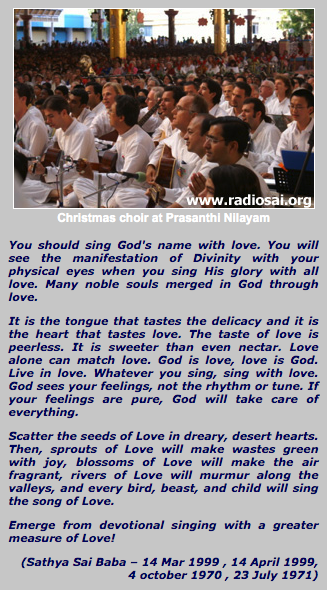
The love that Swami embodies and showers on us all allowed me to revisit my early upbringing. I came to realise that the God/Jesus that I had feared and denied was nothing but the extension of my family’s fear and their need to make sense of a world that was lacking love.
Further, their love for me took the form of needing me to be like them, to believe like them and to ensure my going to heaven with them. They didn’t want me to burn in hell for eternity.
When I could look at their beliefs from this perspective, I was able to understand them and their actions. My fear and distrust of Jesus receded. My family continued in their beliefs and saw my love for Swami as an indication that I was certainly on my way to hell.
I felt sorry that they were not able to see what I saw in Him. I had felt pure selfless love the likes of which I could not have imagined. It saddened me that they were not able to join me in this glorious journey.
I don’t just believe any more – I know that our Beloved Bhagawan is indeed the Father of Jesus as He is the father and mother of all. I also know that since the passing of my parents and grandparents, they will have had the opportunity to see and know Swami as I see and know Him as the embodiment of total love and compassion, the supreme one who created and sustains all. This brings me great comfort and allows me to let go of the sadness that was a large part of my younger life.
What relationship do I have with Jesus now? I see him as an older brother who exemplified complete surrender to God. I look at his dedication to God and am humbled. I no longer think he will give God a list of my misdeeds.
I am grateful that Jesus taught and lived the way of love. I am comfortable with the understanding that for some people Jesus is the only way, just as I am comfortable with the understanding that there is a religion that is suitable for all at whatever stage of spiritual life they may be. My perception of Jesus and what he exemplified has freed me – by his example of unconditional love and obedience – to completely open my heart to his father.
I offer my complete gratitude and overwhelming love to Bhagawan Sri Sathya Sai Baba, my dearest and most beloved Swami. He has given me a life sweeter than I could have ever dreamed of. By His Grace, He is truly my very best friend.
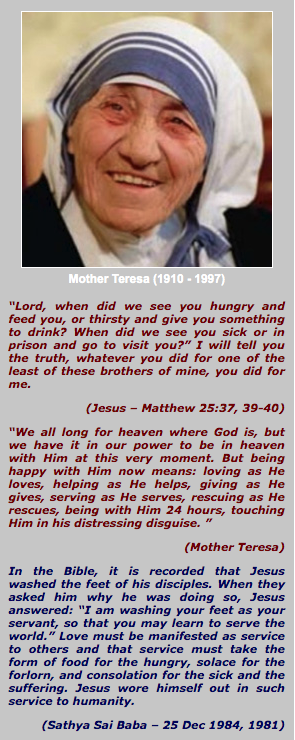
Sylvia experienced a breakthrough in her life, but it was one she had been seeking since her teenage years. For Victor Kanu, co-founder of The African Institute of Sathya Sai Education, the breakthrough came much more as a surprise. During his interview with Radio Sai, hosted by Dr. Venkataraman, Victor tells how Sathya Sai Baba transformed his life into one of selfless service, just as Jesus taught his disciples.
HANDS THAT HELP ARE HOLIER THAN LIPS THAN PRAY
Victor Kanu – Zambia
\
I started my career as a schoolteacher and headmaster of a large Roman Catholic Primary school in Lunsa, Sierra Leone, before proceeding to Oxford University in England for further studies in philosophy, politics and economics. After that I became my country’s High Commissioner to the United Kingdom. It was after that that I came in contact with Bhagawan Sri Sathya Sai Baba in a miraculous way. This was in 1975.
I was living a very high life, being a High Commissioner; the booze was a regular thing. In a dream two angels took me to an unknown place which I later discovered to be Prasanthi Nilayam itself. They left me at the main gate of the ashram, where I met all of the religions of the world including my African ancestors. When I woke up, of course it brought about a tremendous change in me that I could not explain how or why it happened. The things I used to do, like going to the parlour and smoking, gradually faded away. This is how Baba first called me. This was an extraordinary turning point in my life and also a transformation point.
I began to take spiritual matters rather seriously. Even though I had been brought up as a Christian I had stopped going to church. But after this experience I began going to church and reading the Bible. And I became interested in Western philosophy.
I have never seen a contradiction in going to my Christian church and following Sathya Sai Baba. In fact, the more I came to know Baba, the better I became as a Christian. I gradually loved Jesus Christ more so than ever before and I understood the Bible more so as a result of my contact with Baba.
Although Baba has immense power and immense influence, he tells people to stay where they are, be a good Christian, be a good Muslim. This is in agreement with his teachings that there is only one religion, the religion of love. He says he has come to water the roots of all religions, not to uproot them, but to freshen them up.
When I finished my job as High Commissioner, Mrs. Kanu and I engaged ourselves in teaching with the Inner London Education Authority. This is what brought about our active contact with Sathya Sai Baba. In 1980 we came to Puttaparthi to attend the first overseas Bal Vikas teachers training course; we were among the first to be trained on Swami’s “Education in Human Values” (EHV) programme. It was an eye-opener after that course. We liked the programme so much that we felt this was the answer for Africa. So we started implementing it in the London schools and gradually our interest in returning back to Africa grew. We saw that this was the programme that could transform, unite and also integrate Africa.
We had visited Zambia very briefly to conduct a workshop; that was all. We knew no one there except a few devotees. When we came to Baba in 1987, he placed his hands on our heads and said, “Go to Zambia and spread my message of love. Build a school. Spread my message through education and help the people.” So it was Baba who chose Zambia for us.
I remember during that interview that my wife was brave enough to ask Baba, “How about funding?” Swami said sell your house; if that is not enough borrow from the banks. We were delighted when he said this to us.
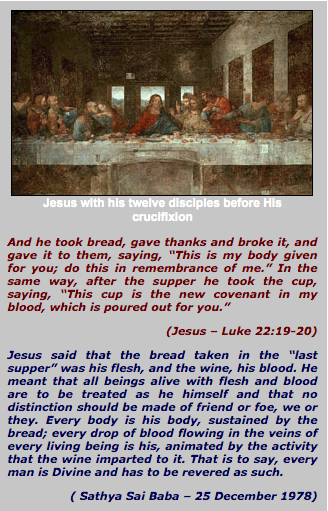
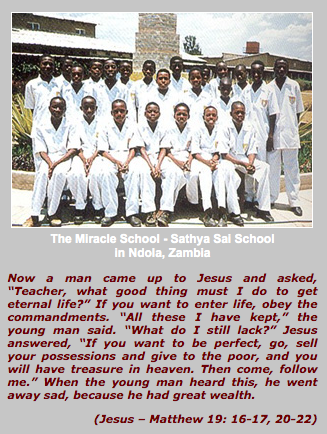
Being brought up as Christians, we remembered the story in the Bible where a rich man went to Jesus and said, “Oh Lord I’ve done this and I’ve done that, what else can I do to enter into the kingdom of God?” And Jesus said, “Sell all that you have and give it to the poor and follow me.” After Jesus said that, the man ran away.
We didn’t want to run away. We were so thrilled that Sathya Sai Baba, whom we believed to be God incarnate, gave us this test and we did exactly what he told us to do.
We were not afraid at all. The country was new to us. But we remembered the stories of other disciples who had gone to distant lands, the Lord was with them and that was all we needed. We knew that Baba was with us throughout.
When he told us to go to Zambia, he did not tell us we would not face difficulties. Difficulties are a part of life and when you are doing God’s work you face even more difficulties and more tests. We enjoyed every bit of them; we knew this was the Lord testing us.
Our school in Zambia is called a “Miracle School”, first because of its location. The school is in a disadvantaged area of Ndola with very poor infrastructure, very poor roads. We could have built it in the middle of the city, but I sent Mrs. Kanu to ask Baba where to build it and he said to go to a poor area and start with a boy’s school. We started the primary school and collected the dropouts as our first students.
This was all part of the Divine plan. When these students took their first national tests, they had top scores. The nation was stunned. How can a school that is located in a village among poor children do so well?
This was the first time in the education of Zambia that they had ever experienced this. So their results were outstanding, their character improved, they became good boys in a short period of time.
This also made a tremendous impact on their families. In one instance, a boy insisted that his father take him to school early in the morning. After dropping the boy to school, the father would report to work.
Within six months the father got a promotion because he was now the first person to show up for work. There was another man who was a managing director who also dropped off his boy and started going to the office early. The late attendance of his employees reduced.
There are so many testimonies from the parents and from the children. There are boys who never used to study who now began to tell the others to study; they would give others’ advice. When we opened the school in 1992, there was only one family who could afford to bring their son in a car, but after this our school started attracting good students. Today we have 30-40 vehicles, including Land-Cruisers, coming from town to bring their children. Five years ago we started a separate school for girls. Many of our students have gone to universities and are now involved in teaching. Many are engaged in the police forces.
When we first came to Ndola, we worked on Saturday and opened the school on Saturday. Today, all of the schools are open on Saturday. From this the people came to know that part of our success was due to hard work. Work is worship, commitment. Now all of the boys and girls in Ndola take their studies much more seriously than ever before. We are also very much involved in community work.
In surrendering to Jesus’ message to “sell all you have and come follow me,” Victor has dedicated his life in selfless service to the education of poor children. Debra Miller, co-author of Human Values at Work and co-compiler of the Be Like Jesus book, likewise experienced a time of surrender, one that led her to a deeper knowledge of the universal purity of Jesus’ teachings.
THE KINGDOM OF HEAVEN IS WITHIN
Debra Miller – USA
I grew up in mid-America where my mother was a devoted Christian and made sure that my four siblings and I were active in all of the church activities.
I loved going to our Southern Baptist church and wanted all of my friends to go to church. I played the piano at the church, and my mother taught the children’s classes and sang in the choir.
Because I had always talked to God personally even from a young age, I had never felt comfortable with the idea that God was a punishing Father and that I had to live a strict life for fear of his wrath. In my early 20’s I wanted to explore the world and became disillusioned with the attitudes of the people in our church. I decided to leave the church and focus on my college and career.
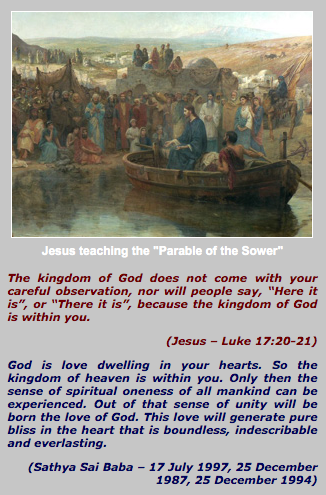
I was doing very well in my career and had a lot of worldly success to my credit when, in my early 30’s, I had a deep spiritual awakening of the heart while at my brother’s marriage. In what seemed like the twinkling of an eye, I had an experience of God’s Divine love that changed the course of my life. It was like I experienced what Jesus meant when he said the kingdom of God is within us, in our hearts.
Still apprehensive about getting re-involved with the Christian religion, I began to seek the meaning of spirituality and how to comprehend and live God’s will in my daily life. I first pursued metaphysical, new age teachings; and while they opened my mind and heart to new levels of awareness, I felt I needed more.
I then spent many years practising the Buddhist Vipassana meditation where I would go into silence for 10 days at a time. It was in practising this meditation that I discovered how much I loved spiritual teachings that were universal, rather than the more narrow teachings that I had grown up with.
In 1999, I met my husband. After we married, he brought me to India to have Sathya Sai Baba’s Darshan. The moment I saw Swami enter the portal of the Sai Kulwant hall, I had the same experience of God’s Divine love that I had had 12 years earlier at my brother’s marriage.
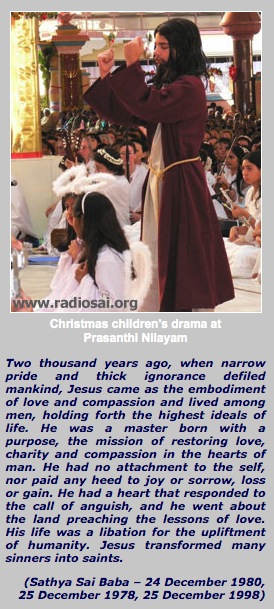
I knew in that moment, from direct experience, that Swami was God incarnate, here to establish the kingdom of divine love within every heart and all of society.
In the year 2000, my husband and I sold or gave away our personal belongings, left our home in the USA and moved to live in the ashram. We initially immersed ourselves in Swami’s teachings and the Bhagavad Gita.
We began to devote ourselves to Swami’s work, first by writing a programme with another couple from Denmark on Swami’s human values for working people.
After moving to India, my sister-in-law, who is a strong Christian with an open mind, began to ask me questions about how Sai Baba’s teachings correlated with Jesus’ teachings.
I honestly did not know how to answer her questions – once I had left my Christian upbringing, I had no wish to return to the Bible.
My husband, however, was very excited about her questions, as he had found his Christian upbringing had come alive for him after he began following Swami’s teachings in 1982.
So we began to read and study the Bible in the evenings and began reading a book we had on the teachings of Christian saints and mystics over the last 2,000 years.
In those early days, I lamented that I would much rather be studying the Bhagavad Gita or Dhammapada than the Bible, but I could intuitively feel Swami prompting us to continue our study and our talks together.
One evening when we were looking at a particularly confusing statement Jesus had made, my husband related it to Swami’s teachings and was able to explain it in a simple way. I was amazed.
I said to him, “I could get really excited about studying the Bible if we could rewrite it from this universal perspective based on Swami’s teachings.”
That night when I laid down to go to sleep, I asked Swami if he would give to humanity a book that would explain the life and teachings of Jesus, just like he had done with Krishna in the Gita Vahini, a book he wrote through a series of articles for the Sanatana Sarathi magazine many years ago. I had a longing to know the truth about Jesus and I had so many questions. I felt that Swami was the only one who could really explain that truth to me and answer my questions.
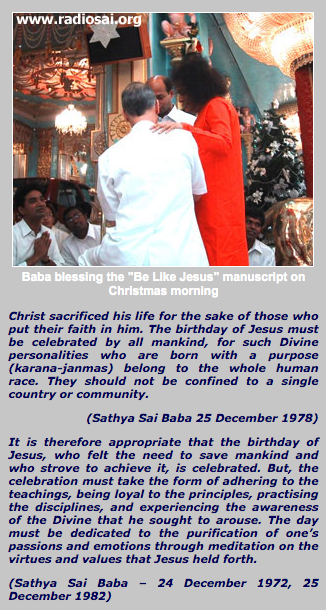
The next morning I wrote a letter to Swami and then explained to my husband what I was feeling. He felt the same longing as I. We both signed the letter and he took it to Darshan where Swami came to him and readily accepted the letter with a smile. We had no idea what would unfold after Swami took the letter, but we had the full faith that he would somehow answer our prayer.
Months passed, and my husband began writing a series of scripture-based essays about Jesus’ teachings that would begin the process of answering the questions that my sister-in-law had asked. I was still not very interested in spending that much focus on the Bible and so I hoped that I could simply edit his essays and not have to get too involved.
One day when Swami was giving a discourse I felt that he was guiding me to stay home from Darshan, although at the time I didn’t know why or how long it would last. The next morning I said good-bye to my husband as he left for Darshan and then settled in a chair and asked Swami what he wanted.
His guidance was to focus on the Jesus essays my husband had begun. Over the next week, I began to delve deeply into Jesus’ teachings. Using Swami’s teachings to guide us, my husband and I began to discover new ways of understanding what Jesus meant.
One morning while I was alone and quietly working on an essay, I heard Swami’s voice speak to me, which was very rare, as I usually only received impressions in my mind and had to use my heart and conscience to figure out how to interpret them. But the voice was clear and indisputable: “I’ve already said everything I need to say about Jesus, and I will show you how to put it together.”
I was stunned, and yet the clarity of the words and the impression that was left on my heart and mind was undeniable. I knew that Swami was giving my husband and me the assignment to be his instruments to compile his words about Jesus’ life and teachings into the book I had prayed for.
I had no idea where to begin, but Swami guided me every step of the way. He chose every word and every expression exactly as he wanted it to be. In many ways the experience, which lasted five months, was like being in another time and reality. It was as if my husband and I were living, breathing and experiencing what it was like to sit at Jesus’ feet and have him tell us first hand who he was and the truth of his teachings.
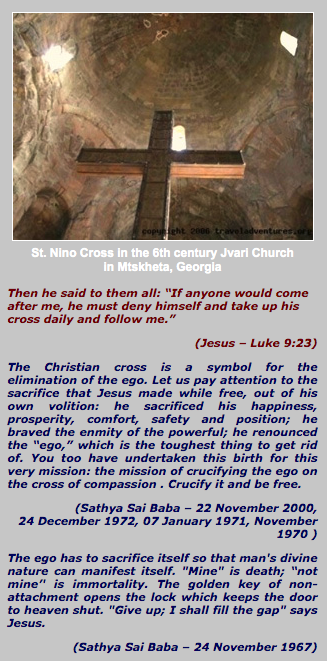
On a practical level, Swami first guided me to compile all of the Christmas discourses into one Word file that I could go through and select text from. As I went through each Christmas discourse, word by word, he showed me by a distinct inner impression which text to extract and how to begin putting the text together in specific groupings. As I was going through this process, Swami also identified key words that I would later use in order to find teachings he had given about Jesus or Christianity in other discourses. These were words such as: Jesus, Christ, Messiah, Saviour, cross, crucify, Mary, etc. It was also clear to me that he only wanted his words from published discourses to be used; we were not to use any other sources where devotees were reporting what Swami had told them about Jesus.
|
Once all of his discourse passages were extracted, Swami began to show me how he wanted them to flow in sequence throughout the book and how to integrate them in those instances where he had told the same story with different nuances in different discourses. Throughout this time period, I was having many intimate experiences with Swami as I asked him question after question and he responded with answers to each one. I had often heard the young men from Swami’s university speak about how Swami attends to every detail of their lives and projects. I experienced this same level of Swami attending to every detail of this book, even making sure the grammar was consistent between the translations of the 60’s and 70’s and those of the 80’s and 90’s. Furthermore, instead of simply giving us a book to read about Jesus, he gave us the direct experience. One experience I had was when I was reviewing a full draft of the book and noticed that in the English translation of Swami’s discourses they had used the word “treason” instead of “blasphemy” to describe the accusation the Jews made against Jesus. I talked this over with my husband and asked for Swami’s guidance to which I felt he approved of us changing the translated word from “treason” to “blasphemy.” After we had completed the transcript, received Swami’s blessing of it on Christmas morning 2003, and turned it over to the Sri Sathya Sai Book Trust, we were documenting all of the discourse references when I found another place in the book where the word treason was used. At first my mind reacted and I felt frustrated that I had not done a full search of the book and replaced it everywhere. But I immediately felt Swami’s prompting inside and sat down quietly to ask him if it was okay for us to change the word. I clearly received a “no”. I was totally confused. It seemed incorrect to me, and I even argued in my mind to Swami that it should be changed. Several days later we were speaking to a gentleman from the Book Trust, and my husband was explaining some Christian history about Jesus that I had never learned when I was growing up. He explained that when the Jews accused Jesus of blasphemy against God, it was not a crime that he could be crucified for. So they took him to the Roman officials and told them that Jesus was asserting himself as the King of the Jews and therefore he should be crucified for treason against the Roman Empire. |
I had never known this distinction before. I couldn’t wait to run home and see if this is why Swami told me not to change the word. Upon checking the book, I found that when Swami had approved of the word blasphemy, it was in reference to the Jews; when he had disapproved of changing the word treason, it was in reference to the Romans.
Swami answered my every question about Jesus in a simple, clear way. He affirmed that Jesus was a Divine incarnation, a master born with a purpose to awaken humanity spiritually. He affirmed that Jesus’ life showed us the path to liberation, and that the path he taught, through both his example and teachings, could lead us to full enlightenment.
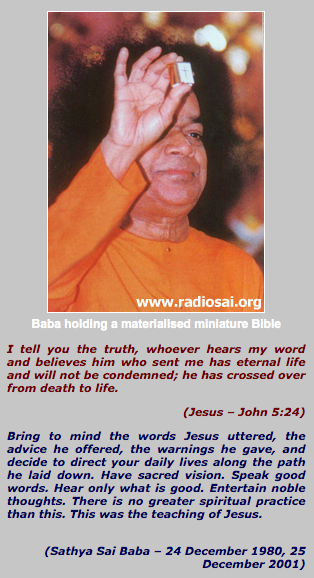
He clarified how Jesus always pointed the people to God and not to himself, and that he taught that we are all Divine, children of God, and that God is one. From this experience and with the presence of Swami, I have been able to continue to embrace and delve deeply into Jesus’ teachings to understand the underlying purity that is universal to all of humanity.
I can now honestly embrace my Christian upbringing and understand its purpose and meaning in this “Kali-yuga” age of materialism, disillusionment, and violence – something I never dreamed would happen.
Debra came to appreciate how Jesus’ life and teachings could enlighten us all and give meaning to our lives. Peter Phipps, author of Sathya Sai Baba and Jesus Christ: A Gospel for the Golden Age, had a dramatic experience of the power and love of Jesus in transforming even the most tragic of circumstances. From this experience, and his devotion to Sathya Sai Baba, he has embraced his mission of preparing Christians for the Second Coming of Christ.
FATHERHOOD OF GOD AND BROTHERHOOD OF MAN
Peter Phipps – New Zealand
(Excerpts from Chapter 1: My Personal Transformation – Sathya Sai Baba and Jesus Christ: A Gospel for the Golden Age)
My origins are within a fairly traditional Christian setting, having been raised as an Anglican, confirmed by the Archbishop of Canterbury, Geoffrey Fisher, and having struggled with my faith for years.
At one stage I had applied for admission to Holy Orders (Anglican terminology for ordination as a priest), and came within six weeks of admission to theological college before a letter from my vicar to the bishop led to an abandonment of these plans.
However, I maintained my interest, and continued to study theology and comparative religions. My faith waxed and waned over the years. I felt compelled to believe in God as a logical probability, but had little sense of a personal relationship with the Deity. I believed in a Creator, but not the Personal Guide, Friend and Heavenly Father whom I have now come to know.
I qualified as a psychologist in the early 1960’s and worked in the prison system, the New Zealand Army and private practice before I joined The Salvation Army as a salaried employee. I still believed in a Creator, but could find little evidence that He (or She) took a personal interest in what we do, any more than the force of gravity distinguishes between one person and another.
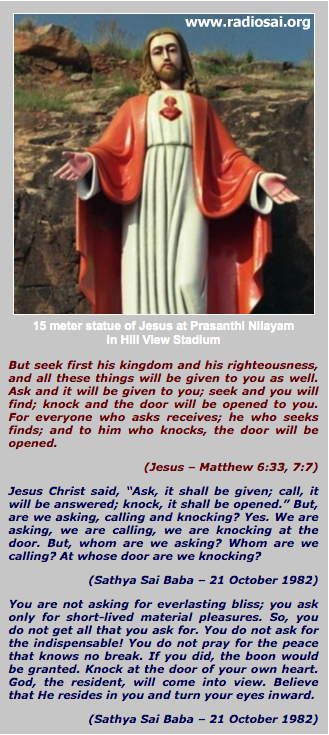
Then my life and belief system changed, literally between one day and the next. In 1990, a man gunned down 13 people. I was one of a team of three on a Crisis Intervention Team sent into the area to counsel the victims. We were part of a Victim’s Task Force established for that purpose.
Thus began the most harrowing and spiritual two and a half days of my life. We counselled over 100 people between us, as victims told us their story and received affirmation for their feelings. We saw victory over tragedy again and again.
We have accepted such violence in Beirut or Northern Ireland and have become immunised to it. I now know that such horror affects real people who also weep. The world does not have to be so unloving and hateful. The team learned that with love all things seem possible.
I have the sense that this Earth could be Paradise if only we loved one another. The gospel seems so practical, so “here and now”, so non-mystical. Heaven does not have to be in another plane or in another place; we already have it, if we only knew it.
All of us on the team felt that we were operating with a power beyond our own. The energy available to us was phenomenal! We knew that others were praying for us and thinking about us, and this helped.
The power seemed mightier than that available at most times. I felt that the power of Christ was available to use directly, and it contained wisdom, power, love and caring.
On the second morning, I woke up with the thought that the easy way of working, using (or being used by) a Higher Power, was the way that Jesus must have worked. The whole Christian story made sense at a higher level than before.
We saw people turn around from a state of confusion and shock to positive action. Some people have told us we were wonderful – but we do not feel at all wonderful, rather that we have access to a wonderful power which we may rightly call the Holy Spirit. What we feel is the great privilege to have been of use to others and to the Lord.
On the way home after the events described above, I thanked God in my heart for the help He provided, and I got a very clear reply: “I am greater than you know; seek Me out and find Me.” This message implied that there was the possibility of finding the source of the message, and so I determined to explore and find the Source.
I had had the sense for a long time that Jesus was not fully revealed in the teachings of the churches or in the Gospels of the New Testament. Somehow the essence of the Man and the Revelation of the God seemed a bit misty.
In search of the deeper truths I started in a bookshop dealing in esoteric texts. My intention was to sift through everything I could find no matter what the origin and use my discrimination to sort out the truth from the bizarre. I had had such a taste of Jesus that I was confident of knowing the difference. In the bookshop, one text nearly leaped into my hand.
|
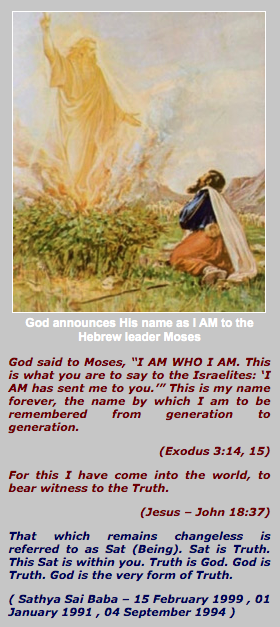
I have found Christ to be indeed greater than I know. I am closely involved with my own church and am working to be a lay reader. I believe I have a great understanding of Christ, and that I have actually been in His physical presence. The mission that I feel I am being called to undertake is to help Christians prepare for the acceptance of the Second Coming.
I preach Christ in the form which Christians know Him, but from the perspective of His teachings in the current age. The message is essentially as Jesus gave us in the Sermon on the Mount and stresses the Unity of all Creation, the Fatherhood of God and the Brotherhood of Man.
IN CLOSING…
As we reflect upon the significance of Easter – not just for Christians but for people of every faith – we are again reminded of Sathya Sai Baba’s words from the opening of this story:
What is the resurrection, really? It is the revelation of the divinity inherent in man. (28 February 1964)
What was the key that Jesus gave the world to realise our inherent divinity? His message is contained in one word: Love.
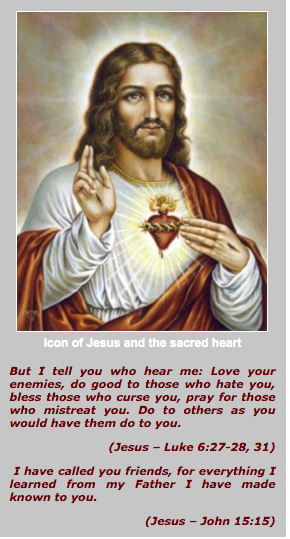
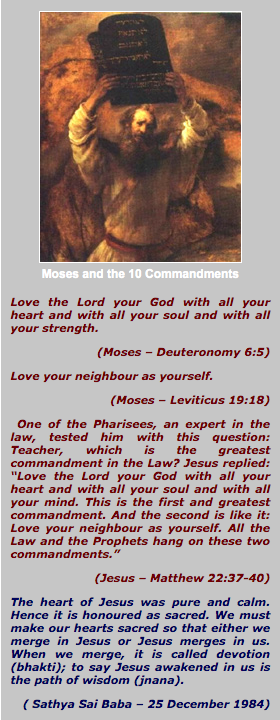
Love the Lord your God with all your heart and with all your soul and with all your mind. This is the first and greatest commandment. And the second is like it: Love your neighbour as yourself. All the Law and the Prophets hang on these two commandments. (Matthew 22:37, 40)
Christmas morning at Prasanthi Nilayam
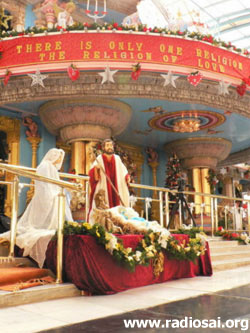
While the message of love, this commandment of love, may seem difficult to live up to in our daily lives, from it springs the promise of resurrecting humanity from the trials and perils it faces today – replacing selfishness with selflessness, animosity with unity, religious tension with spiritual respect, and personal estrangement with a renewed experience of the presence of God. As Sathya Sai Baba reminds us:
The followers of Jesus have broken into schisms on various counts; but the life of Christ is a lesson of unity. He taught people that there was only one God and all were His children. Recognise in each being, in each man, a brother, the child of God, and ignore all limiting thoughts and prejudices based on status, colour, class, nativity and caste. (24 December 1972, 25 December 2001, 01 March 1974)
Jesus showed the path to unity and never gave scope for multiplicity. He always said that all were Divine. In terms of physical form, human beings appear different; in terms of the Spirit they are all one. This is the truth propagated by Christianity. (25 December: 2001, 1991)
The foremost need today is for everyone to realise that God is One. This is what Jesus proclaimed. God is and can be only One, not more! There is only one God and He is omnipresent! There is only one religion, the religion of love. There is only one language, the language of the heart. The followers of every religion, in their own way and style, call upon the One God who is omnipresent. It is the same God who confers upon all mankind, health, prosperity, peace and happiness. (25 December: 1994, 1970, 1978)
Each person we have met in this cover story has experienced an awakening of this “oneness of God” and our collective “oneness in God.” This is not surprising, since the lives of both Jesus and Sathya Sai Baba have embodied this fundamental message of life – thus turning the hearts and minds of people everywhere towards knowing the changeless nature of God, the loving presence of God in their lives, and the truth of their own inherent Divinity as children of God.
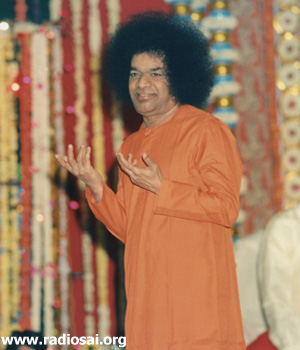
The influence of Sathya Sai Baba in the lives of countless Christians has led to a resurrection of their relationship with Jesus, a rebirth of appreciating who Jesus was, and a renewal of their sincere practice of what Jesus taught. The result has been, time and again, lives fulfilled as good Christians, true Christians, better Christians.
Dear Reader, did this article inspire you in any way? Please write to us at [email protected] mentioning your name and country. Thank you for your time.
- Team SSSMC
Featured Articles
No articles found
Try adjusting your filters or search terms.