

The Sai Pancharatna Kritis are special Carnatic compositions describing the life story and the glory of the Sathya Sai Avatar. They were first presented at the Lotus Feet in the year of Swami's 90th Birthday on Aradhana Day 2015.
The Sai Pancharatna Kritis are special Carnatic compositions describing the life story and the glory of the Sathya Sai Avatar. They were first presented at the Lotus Feet in the year of Swami's 90th Birthday on Aradhana Day 2015.
Subsequent to this presentation, in answer to many devotees' queries, we had many live Radio Sai discussions about the making and the meaning of these compositions in our programs “Outside Inside Deep Inside” as well as “Morning Glory”.
Presented below are edited excerpts of the 'Outside Inside Deep Inside' discussion which had as its participants, SSSMC team members, C. G. Sai Prakash (CG), Anirudh Srinivasan (AS), and Bishu Prusty (BP), as well as Ms S V Vasumathi (SVV), the Vice Principal of Sri Vishwa Vidyalaya Matriculation High School, Chennai. In this episode, they dwell on the musical beauty as well as the profound depth of the lyrics of the fourth Sai Pancharatna Kriti – “Kaliyuga Avatari”.
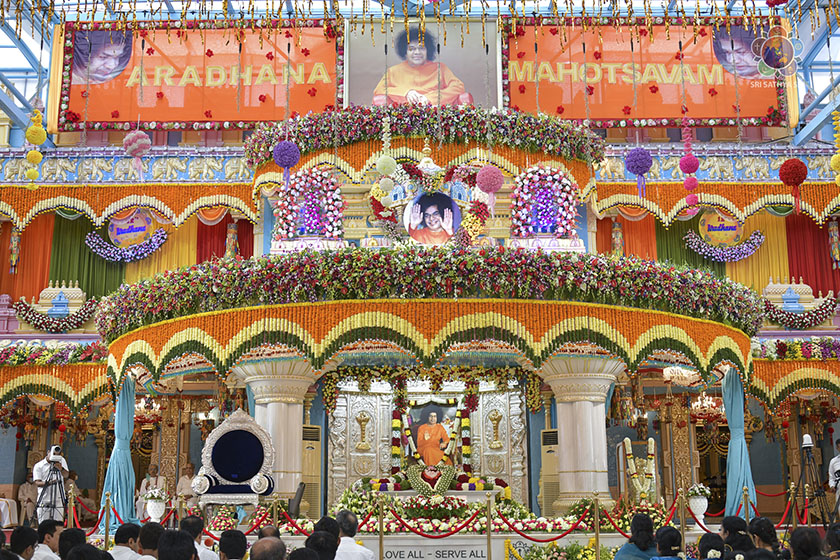
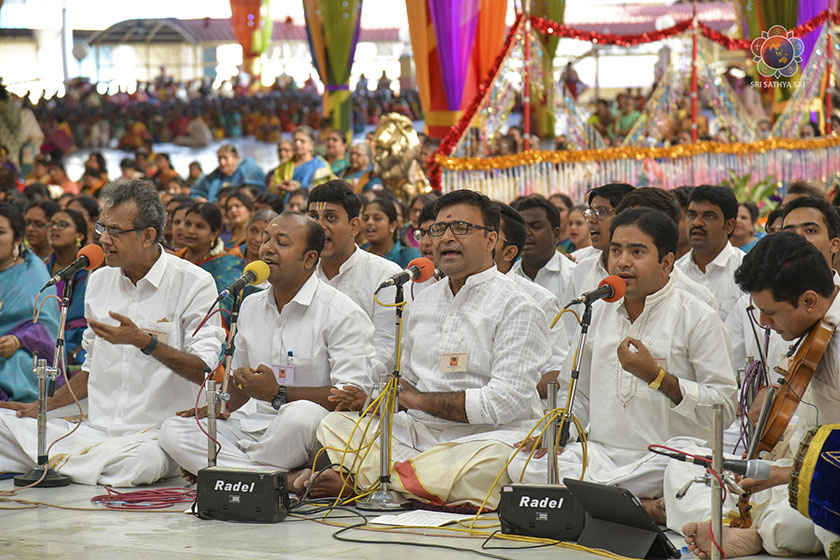
Bishu Prusty (BP): Joining me in today's discussion are brother Sai Prakash, my colleague, and sister Vasumathi, the Vice-Principal of a Sai school in Vandalur, Chennai. She was very fortunate to be part of the team that presented these kritis in the divine presence on April 24, 2015. She was accompanied by students from her school who are excellent vocalists. They learnt and sang these kritis and really lifted up the occasion on Bhagawan's Aradhana Day in Sai Kulwant Hall.We will now listen to Sai Prakash and sister Vasumathi dwelling on the fourth of the Sai Pancharatna Kritis: ‘Kaliyuga Avatari Bhagawan’.
The fourth kriti is arranged in the crown jewel among ragas, Todi. All the Carnatic singers would agree that this is not one of the ragas for amateur singers. It is a very challenging raga.Even someone who knows Todi cannot sing this kriti and has to be really an expert in the raga.
CG Sai Prakash (CG): That's right.
BP: Todi allows the singers to exhibit a wide range in creative tonal modulation. The raga is such that it gives every opportunity for the singer to express his/her creative potential. So this Sai Pancharatna kriti in Todi too gives every opportunity for the singers to express their creative potential in terms of their technical skill. At the same time, it expresses deep adoration for the Avatar.
We have seen the first three kritis describing first the glory of Bhagawan's advent, His divine aspects and then His human aspects. I feel that the third kriti is very significant because it is that part of Bhagawan's story where He was building the human capital for everything that had to come about.
CG: Correct.
BP: Bhagawan first started the colleges with the Veda Pathashala because in future, the Veda Movement had to start. Thus, very early, He started the colleges so that by the time His projects came, there was already a band of sincere people who were willing to dedicate their lives to His mission.This fourth kriti glorifies how He used so many instruments to start the work of amazing humanitarian projects that would always leave even sceptics in awe.
CG: True, but these projects were done with compassion and love. When someone said, “Swami, the Grama Seva is such a huge effort. All over the press and media, people should know that such tremendous seva is going on,” Swami replied, “If a mother gives food to her child, will you advertise it in the newspaper?” He was totally against publicity not for any other reason but the fact that He really thought of everybody as His own.
When He built the hospital or did the water project, it was just a feeling of serving His own family and His own people. The phrase ‘naa hakku’ from the third kriti still comes back to me. He extends that ownership feeling on everybody!
There is a line in this kriti which says, ‘Parulu parule kaadu paramaatma roopulana’ which means ‘Others are not others but they are God themselves’. He was always in that state of awareness by which He always did things for His own people and so there was no need for any publicity.
There is a beautiful point that needs mention here before we get into this kriti, which deals with His mega projects. I heard that many of the farmers and others who had to give their land for the water project gave it away willingly. In no other government project will this happen! Even if the government said, “We are going to give you water. So give your land,” there would be hesitation. But when it came to Swami, they knew that the moment He gave His word, it would be fulfilled. With that love, confidence and faith, things take on a totally different scale!
In fact, in an interview with Shri Ramakrishna and Shri Kondal Rao, the engineers responsible for the project, they said, “The way the Anantapur water project has been executed is amazing.” That's because the only things that drove this project were love and compassion!
They said, “We've never executed a project of this magnitude before but it went on so smoothly because it was done with love.” Bhagawan would be waiting in the mandir every day and they had to come back and report the progress to Him.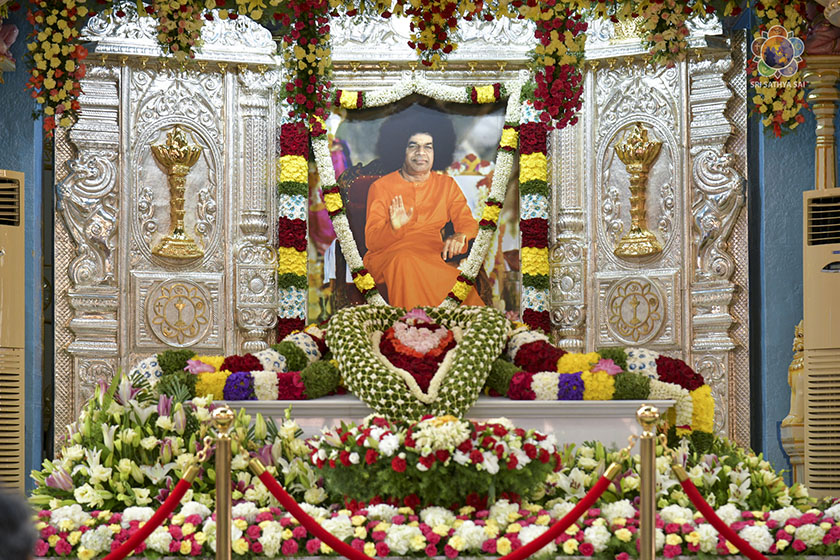
BP: I remember that summer, Swami did not go to Brindavan or Kodaikanal. He was in Prasanthi Nilayam in 1995. He stayed put and went on helicopter rides to oversee everything.
CG: Let's get into this beautiful composition composed in the king among ragas, Todi. It is very challenging to sing it because every note is in sort of an oscillation. There are no static notes in this raga and every note is like a gamakam (vibrato).
SV Vasumathi (SVV): That also varies. The extent of oscillation for the same note will vary at different places. You will never know how to sing a particular note. In one place, you will have to sing it a particular way but in another place in another way. Hence, it is really challenging to learn it.
CG: Even if you take a kriti composed in raga Todi, it would have certain phrases that are expected but the way Raj Kumar Bharathi Sir has composed this kriti is very unique. Some of the musical experts who heard this kriti said it is a masterpiece!
The pallavi of this kriti is ‘Kaliyuga Avatari Bhagavan Shri Sathya Sai’ and the anupallavi is ‘Paalita Jana Mangalakaari Paavana Chitraatata Vihaari’. The pallavi refers to Bhagawan being the incarnation of Divinity in the Kali Age. The anupallavi means: “You look after the simple folk by bestowing auspiciousness on them. You dwell on the banks of the sacred river Chitravathi.” Charanam 1 says, ‘Prema Sudhaapooram Seva Saundaryabhaasitam’ which means “You are full of nectarous love and You shine with the beauty of service.”
BP: Beautiful words!
SVV: Lyrical beauty is there.
CG: ‘You shine with the beauty of service.’
BP: That is how Swami wants each one of us to be!
CG: Here, already we are introducing the concept of service and what is to come later in this kriti—the mega projects of Bhagawan. But there are a few more charanams before we go to the projects. Charanam 2 says, ‘Darahaasa Vilasita Vadana Sarojam Kutila Kuntala Viraajamaanam’. I think we should listen to this charanam.
BP: Sure.
CG: The reason I said we must listen to this charanam is because of the way the tune has been composed. The meaning is “Your flower-like face shines with a bright smile. You are adorned with curly hair.” Such a beautiful description of Bhagawan! The smile on His face is like a fully blossomed flower and that is how the tune is also composed—slowly, like a flower blossoming!
SVV: I remember the picture you had used. For every charanam, you had put an appropriate picture of Bhagawan on that day. The picture for this charanam was really beautiful and very apt!
CG: As every kriti was being sung, we had slides inserted to display the lyrics of every charanam and the meaning with an appropriate picture of Bhagawan.
BP: This was unlike ‘Prema Pravaham’ which was a complete visual. This was a semi-visual.
CG: But it gave almost the same feeling because when you see that photograph, it's like a moment captured in eternity.This particular smile and this photo are really beautiful; it is a side-profile picture.
The next charanam says, ‘Nee Mridulaadhara Nirgalita Vaaksudhalu Groli, Mari Mari Talachi Talachi Pulakinchi, Muktamatulayye Supta Chittamulu’. It means, “Soaking in the nectarous words emanating from Your tender lips and contemplating on them over and over again, filled with ecstasy, the minds that were in slumber are awakened to the reality.” It talks of Bhagawan's discourses because in a way it was in those discourses that He actually declared all His projects!
BP: He stunned everyone!
CG: Including the Central Trust members! They were totally taken by surprise because these were not planned declarations. They were spontaneous outbursts of His love and compassion. ‘Mari Mari Talachi Pulakinchi’ means “Listening to Your words over and over again”.
I have myself watched the video clip of the declaration of the Super Speciality Hospital so many times. Bhagawan is on His toes as He's making the announcement when He's giving His discourse! First of all, it is such a unique gesture that He stood and gave discourses. Till the time His physical body could stand and take the strain, He did it! He felt that was ‘sabha maryada’ or ‘respect for the stage’.
SVV: And all of us would sit!
CG: Yes! But when He was declaring something, one could literally see Him on His toes and raising Himself up! If given a chance, I think He would just float in the air! So beautiful and so completely involved and in the moment.
BP: So excruciatingly eager!
SVV: Yes!
CG: It's like the Ganga coming out from the source! Bubbling with joy and an element of surprise. He is Himself surprised with the announcement He's making and of course, the whole world is surprised! So we have to keep listening to all that He said again and again. The line “You awaken our minds from slumber” refers to our minds that have gone to sleep and that are very comfortably asleep! To such minds, He says, “Get up!”
SVV: I'm just reminded of one thing you said, Prakash. Raj Kumar Sir said that the ragas chose the kritis. In this particular raga Todi, even the swaras are pulsating with life! Just like how Bhagawan's heart would have felt for the multitudes! In the other kritis, the swaras are crisp but in this kriti, the swaras also are so much filled with life.
CG: I get what you are saying. In the other kritis, when the swaras are sung, they sound like swaras and the sahityam sounds like sahityam. But in this kriti, the swaras themselves sound like a song! That's because there is no staccato and everything is flowing and one swara blends into the other.
SVV: There's another place also where it's like a flow.
BP: Oh!
CG: You will know it when it comes up later.
SVV: There are so many instances like this.
CG: Even in this charanam ‘Nee Mridulaadhara’, the ‘nee’ is very beautifully composed.
BP: You forget that you are singing a swara!
SVV: It was a new experience to learn this kriti. Frankly, I had no exposure before this in learning Todi raga but the very first experience was like this! We thought,“The swaras are also pulsating with life.” Ha ha!
BP: Amazing!
CG: The next charanam brings to light a particular concept. It says, ‘Kalayo Vaishnavamaayayo’ which means, “Is it a dream or is it reality?” because every project of His is so amazing!
The phrase ‘Satyasankalpa Paramaarthamo’ in this charanam means, “Your resolve of truth is what makes it possible” and ‘Parulu Parule Kaadu Paramaatma Roopulana, Brihatsevaa Pradaayakaa’ means “The spirit with which You did Your gigantic service projects is that others are not others but are in fact the forms of God”. Every project has been undertaken with this as the background understanding and awareness.
BP: It is very beautiful. Before the lyricist talks about the projects, she lays the foundation of the spirit behind them!
CG: Yes! The entire meaning of this charanam is, “You have taught us that others are not truly others but the very embodiments of Divinity and given us the opportunity to participate in gigantic service projects that reflect the power of Thy Divine will and make us wonder if all these are a dream or a divine mystery.”
There are many projects done by Bhagawan and all of them cannot be mentioned in a song like this but the three major ones are mentioned in the next three charanams. I feel that by mentioning ‘Parulu Parule Kaadu’, the feeling with which these projects have been done covers up all the others because it really brings to notice that this is the spirit with which all the hundreds of other projects Bhagawan undertook have been done.
BP: Even if you restrict yourself to the projects of the form of the Sathya Sai Avatar, you cannot restrict them to a few of the initiatives of the Sri Sathya Sai Central Trust because in every samithi, centre and home, there is something happening! All are His projects because everything is an expression of selflessness. I know so many families that have adopted two-three people and take care of them or serve food on a daily basis to a paralysed man. These are also Bhagawan's projects.
CG: In fact, ‘Parulu Parule Kaadu’ is the benchmark. So if you do seva with that feeling and spirit, then it becomes a Sai project. Isn't that true? Bhagawan was never for publicity.
BP: He actually shunned it for a very long time!
CG: Yes. In an interview with Mrs Bhatnagar from Delhi who is an ardent devotee of Bhagawan, she mentioned that she had started a project that came to her very strongly: serving a full-fledged lunch to anyone coming to her house. She just thought of it and felt she must do it.
In the initial days, she found it very difficult because once news spread, people started coming—beggars, rickshaw pullers, drivers, etc. She thought to herself, “I'm doing this in Swami's name and I should not compromise on quality.” She initially put all her savings and got huge vessels and cooks to come and cook. She made sure the food was very hygienic, tasty and nutritious and started distributing. As the news spread, the numbers kept growing and reached a plateau of 150 people per day.
I asked her, “Aunty, how are you managing?” She replied, “But I'm not managing.” Ha ha ha!
I asked, “What do you mean?” She said, “You won't believe it but I have no idea of how the next day's lunch is going to be cooked. Somebody from some part of Delhi gets inspired and comes and tells me, ‘We will take care of tomorrow's lunch.’ They bring the provisions and give to the cooks who make the food. This is what is happening.”
I said, “Now you are in Puttaparthi. What's happening there?” She said, “It goes on. Do you think it's my project? Swami makes sure it goes on.”
When you really feel that others are not others and they are God, then it becomes a Sai project. He takes care and it becomes perennial. It cannot stop! That's the beauty of Bhagawan's projects.
We will now move on to charanam 5. Before I speak anything about it, let us listen to it because this is one of the most beautiful charanams in this entire kriti.
BP: When I heard this, I felt that the word ‘upponge’ is really composed that way.
CG: That's the point! The tuning of that word goes from the lowest to the highest note as if the water is just gushing up and then flowing down. This charanam speaks of Bhagawan's water project. It says, “The compassionate glance of Sai Shiva has given birth to the Sai Ganga Drinking Water Project. That project has slaked the thirst of the drought-struck millions.” The way it's been composed is so beautiful!
BP: You feel like reading the meaning and going back and listening to the kritis again. Then, you enjoy the swaras and the tunes and go back and see the meaning again and return to listening to the kritis!
CG: It's like a diamond with many facets!
BP: You keep discovering and relishing more and more.
CG: Exactly. This charanam is an unbelievable composition! It is so beautiful how the spirit of the entire water project has been captured in these two lines because ‘upponge (gushing forth)’ was the kind of feeling Bhagawan had!
If you see the clips of Him announcing the water project or handing over the project to the Andhra Pradesh Government, you can see His face and eyes radiant and glowing. It's just the joy He feels—“Yes, I'm able to give life to millions!”
SVV: Prakash, I'm reminded of the drama which the children from our school got the opportunity to present in 2008 about the Chennai Water Project. There was a scene where an old man has to travel many kilometres. After standing in a lengthy queue, he doesn't get water and he asks, “What is this fate?” I remember Bhagawan's expression. His heart really melted!
There was another scene about Eshwaramma coming and asking for the three boons from Bhagawan. Seeing the scenes depicting the plight of the villagers who never had any access to water, how they were travelling a lot of distance and still not getting water, and the way they were drinking dirty water from pools and puddles, He was really so moved!
There was also a line in the drama mentioning how the thirst of all the people had been quenched by the Sai Ganga Project. Towards the end, we had a scene where the entire place was flooded with water. The expressions of Bhagawan and the way He blessed all the children really come to my mind now.
CG: That drama was also called ‘Prema Vahini (flow of love)’!
There's another interesting thing. I always had a doubt—“The people in East and West Godavari are right next to the river Godavari. Why do they need a water project?” When Prof G. Venkataraman and I went to the Godavari area where the water project was done, we saw everything and we spoke to the people there. Then I understood their problems.
When we came back here and showed a small clip to Bhagawan, He told us the same problems that those local tribal people in the forests there told us!
He said that in the summer months, the water level is so low that they would have to climb down nearly 40-45 steps and carry water all the way up again from the river. They have to climb up the bund and then go over to the other side. It will break one's back!
SVV: Risky also.
CG: In summer, it is not risky but it's a strain. But then what about the rainy season? Bhagawan said that in the rainy season, the water current is so fast that people just get pulled into it. That was the first point. The second point was something that really moved me because though Bhagawan was sitting here in Puttaparthi physically, He knew exactly the problems the people there were facing.
Bhagawan said, “There is moss on the steps.” In the rainy season, when there is moss on the steps, you cannot balance and carry the pot of water. Your leg will slip and the moment your leg slips and you fall, the current pulls you away. This is exactly the problem that the people there had told us when went to Godavari and Bhagawan was sitting here and narrating the same problem. He said, “This is why it is difficult in the rainy season”. People will wonder, “What's the big deal? You're having such a perennial river flowing right next door.” But these are the problems and Swami went right to the root of the problem.
BP: That's right. ‘Parulu parule kaadu’. When you feel that much for the other, you will know their problem. They don't have to articulate.
CG: Even in the Orissa housing project, Bhagawan was so moved and said, “Are there not rich industrialists? Have they not looted the natural resources of Odisha and built their lives and industries? Are their hearts not melting when they see such a plight? Doesn't matter. I will do it.” That's how He declared for the houses to be built in Odisha, the earthquake relief project and so many other projects. The spirit is conveyed here in ‘Parulu Parule Kaadu’, which means “Others are not others but forms of the Divine.”
We now go to charanam 6. It summarises so many beautiful points. It says, “You are the Divine Doctor.” Often when people asked Bhagawan, “Why did You build a hospital when You can cure everything?” He said, “That's how the faith of people is. They have faith that if they take a medicine or a treatment, they will get cured. If you have full faith in Me, you don't need a hospital. But if you have faith in the medicine, then you need a hospital.” This kind of compassionate God we can't get! Ha ha!
SVV: Ha ha!
CG: Here you have choice also! The lyricist also says, “You are capable of curing even bhavaroga (disease of worldliness)”. We have seen this over and over again. It's not merely what He does in the veranda or elsewhere but once patients are treated in Bhagawan's hospital, their whole lives change.
BP: That's very true. It's not just the bodily ailment that gets cured.
CG: Bhagawan has no differentiation between caste, creed or religion but it is very amazing and surprising to see lot of Muslims who have been treated and cured in the hospital coming back to do seva. They clean the vessels and mop the floors, saying, “This is the hallowed place that has cured us.”
BP: I remember interviewing a patient from Pakistan who had come to Prasanthi Nilayam. I could see with what joy he left the place. His uncle said, “We will go back and tell everyone in our place that Allah has built this hospital as an expression of His love and mercy.”
CG: In fact, seeing the very structures of the hospitals, who will say they are hospitals? They are indeed temples of healing! This charanam about the hospital is so deep that once you go inside and have the experience of the temple of healing, you are really cured of your worldliness.
You forget yourself and say, “Oh! Where can I go and serve? What can I do to serve people?” People are inspired in different ways. Some of them donate medicines, some give equipment, some give clothes like blankets and bedsheets, while some give their time in the form of seva.
BP: In the hospital in Whitefield, the counselling department is so strong. They have 20-30 counsellors who every day go just to speak to the patients and make them comfortable because Bhagawan was so clear and said, “If a doctor speaks nicely to a patient, his disease will be half cured,” because it all begins with love.
CG: There are patients coming in who do not know who Bhagawan is. They just walk into the hospital but by the time they leave, they fold their hands to His photograph. They are moved and their roots are shaken because they wonder, “Does such a place exist on earth?” That is the standard and spirit with which He started these hospitals!
It is really moving to note that Bhagawan felt that the hospital which He built for the poorest of the poor was good for Himself!
When He had to undergo a treatment, He would go only to the same hospital. He said, “The treatment given to the poorest of the poor is enough for Me also. I want no special privileges or treatment.” If He had expressed it, He would have been flown to the best hospitals in any part of the world but He said, “No! What I am giving to My people is good enough for Me.” What a lesson that is!
The more and more we think of it, it just amazes us. So that is charanam 6 where we talk of the medical marvels. Then we go to charanam 7 where we talk of the educational institutions and the university that Bhagawan started. We should listen to this.
What amazing tuning for this charanam! The way Bhagawan has combined ‘padaartha’ (material) and ‘paraartha’ (spiritual) knowledge is amazing. The meaning of this charanam is, “With sacrifice and yoga as the foundation, character-building as the ultimate goal, combining the study of the material and spiritual, the knowledge of here and beyond, this special university is dedicated to imparting the ‘highest’ learning, totally free of any charge.”
SVV: When we listen to the tuning, it's like singing about some celestial university. The tuning of ‘Visishta Vidyaalayam Idi’ is done in such a way! Really, every student will feel proud to say, “I have studied in the university where God was the Chancellor.”
CG: A sense of pride that, “Oh! It is our university that we are talking about here!” The lyricist has beautifully summarised the spirit of the educational institutions.
BP: That's what amazes me. By Bhagawan's grace, she was able to encapsulate every aspect of His life and mission in few words!
SVV: You can write lengthy articles but to put it in few words is very tough and she has done it in such a way as to make us feel that these few words contain all the elements.
BP: Yes. It is very easy to write five pages about a company's goal, for example, but to state that in one vision statement is difficult.
CG: Each charanam is like a beejakshara! It is a condensed version. The lyrics of this charanam are ‘Tyaaga Yogamule Punaadi’ meaning “Sacrifice and yoga are the foundation”, ‘Satsheelame Paramaavadhi’ meaning “Good character is the ultimate goal” because Bhagawan says, “The end of education is character. What I want is that you get a good name for yourself.” That good name can come only with good character!
‘Padaartha, Paraartha Ekeekrita Ihaparagnaana Vaaradhi’ means “You combine the material and spiritual knowledge and give it to the students”. The crux of this university lies in this—how He wanted a hostel life with such beautiful rules such that there is a perfect balance of ‘iha’ (worldly) and ‘para’ (spiritual).
BP: You are fit for the affairs of this world and you are also fit to look after yourself beyond.
CG: It speaks volumes because when students from this university go out into an office and start working, there is a marked difference in their attitude and approach to a problem or situation. It cannot go unnoticed! People are totally inspired and ask, “How did you think of this?”
One student told me when there was lot of dust and dirt near his workplace, he didn't hesitate to start cleaning it. People asked him, “Are you mad?” but he replied, “Why? This is where I'm going to sit. What's wrong in cleaning it?” We students are ready to do anything. At the same time, Sai students hold such high positions and responsibilities. The way they execute them is with love and compassion. So I think the study in the university here has made a very deep impact on all the students.
BP: There is a student working in Bangalore, E. Sreekanth. He has distinguished himself as one of the pioneering leaders of this century in the technology sector and has even won an award. He told me that once he joined an office, he went and spoke to the office boy who served tea, etc.
That person was in tears because he said, “I've been working in this office for 20 years. No one has ever spoken to me like this. If I am late in bringing tea or coffee, people reprimand me but no one ever bothers to ask me whether I have a family, how everything is in my life, whether I need any help, etc.” For us, it is so natural!
CG: That is natural because we have seen Bhagawan and we have been shown that this is the way of life!
BP: You feel that you have to do it. You definitely know that you may do a job but that is not the goal.
CG: The approach of people who go by status, etc., to life is very shallow. A striking contrast comes to my mind. This is what happened during the Gujarat earthquake. Immediately after the earthquake, several NGOs went there to do seva. They were just throwing clothes to the people there and one among them retorted saying, “Don't do this! Till yesterday, we were as well off or even better than what you are today. It is because everything has got destroyed in the earthquake that we are like this today.” Thus, the spirit with which you do the service is equally or more important than the service itself.
SVV: Look at the way Bhagawan trained the students to go for Grama Seva and do it. It becomes natural because we get so steeped into it that it has become our nature. Through the kind of education students are receiving here, He ensured that it becomes our nature to be that way. It is nothing of us!
CG: Exactly. It's just the training that the environment provides.
BP: In my interactions with many former students of our university, what distinguishes them in their corporate life may not always be their intellectual ability; perhaps there are students with much greater IQ. Many of our students are very good but there could be students from the IITs and other institutions with higher IQ. But what I have seen is that all of our students have become what they have because of their great people skills.
Bhagawan called the MBA here as ‘Man Management’ because that is what it is at the end of the day. All the students just by virtue of living in the hostel with 13-14 boys in a room get used to working with so many people. They can very easily adjust with anyone because they have spent three to five years of their life living with someone from Kashmir to Tamil Nadu to Goa. All this gets very unconsciously ingrained.
In fact, when the new hostel was set up (now the school hostel), people suggested to Bhagawan, “At least now let's have a spacious hostel where each boy has a room or at least two boys share a room.” People came forward to donate but He insisted and said, “No! There should be at least seven to eight boys living together and all should sleep on the floor. There should be that evenness.”
I heard something very striking. In China, for very long they had the ‘one-child policy’ and because of this, every child was treated like a king in the house. But the repercussion is that today when the children go out and have to work in an office with many people, they are not able to cope and work with others because they are not used to adjusting with another person.
SVV: Each and every aspect of our hostel stay or studying in the institute and every moment was a learning process.
BP: It's really very beautiful that by Bhagawan's grace, Dr. Vasanthalakshmi has put together these ideas.
CG: We were discussing that the projects are mentioned in the reverse order in this kriti—the water project comes first, then the hospital and then the university.
SVV: I feel it's the culmination—the one closest to Bhagawan's heart comes last!
BP: In some way, this was the foundation.
SVV: Bhagawan used to say, “Despite all this, My only property are My students.” So that had to come last!
BP: True!
CG: The last charanam in this kriti says, ‘Sai divya darshanam ghana paapa naashanam, divya paada sparshanam karmamochanam, Satya Sai sankeertanam aatmaanusandhaanam’. This is also very beautiful and we should listen to this.
SVV: Very emotive! We listened to it about 50 times without attempting to sing it because we thought we would spoil the tune if we tried it. It's really very touching!
CG: Really, this charanam marks the culmination of this entire kriti because of many factors—the way it is tuned, the words and their beautiful meaning. It says, “The divine darshan of Sai relieves one of the darkest sins. The touch of the Divine feet relieves one from bondage of actions. Singing the name of Sathya Sai brings about the union with the Atmic principle.”
BP: That is the ultimate goal! For Bhagawan, all the projects were not the end but a means to the end of union with the Atmic principle.
SVV: After singing about all this, when you come to the same line ‘Kaliyuga Avatari Bhagavan’, you realise the potency of that statement. You keep singing about various things and how His darshan itself is liberating and then you sing ‘Kaliyuga Avatari Bhagavan’.
BP: The other thought that comes to me is that she again comes back finally to darshan and sparshan. That is actually the biggest project of Bhagawan! Ha ha!
SVV: Ha ha ha!
CG: Very correct!
BP: I used to think this way. Forget all other attributes of Bhagawan but just for the very reason that He as an individual for more than 70 years came every morning at 6 or 6:30 and went about the crowd, listening to them, taking letters, He had to be really extraordinary! If one could do that consistently for so many decades, it is amazing.
CG: That is also with the same feeling of ‘I am going to meet Myself’. Bhagawan identified Himself with everybody.
BP: Many times if we want to do something, we are not able to do it consistently even for a week. Imagine Swami doing this consistently for so many decades!
CG: The other aspect is He did it with absolutely no motive.
BP: That's why He was able to do it.
CG: We might think that somewhere He might want something, but really He has no expectation because that is His nature.
BP: Amazing things are achieved only with great love!
CG: Great love and selfless, divine love. Since He has given water to the people of Andhra Pradesh, did He expect anything from them? He has given free education to all of us. Did He ask for anything at all? In fact, if we tried to offer something He would bless and return it back.
BP: Whenever we tried to give our first salary to Him, He would say that.
CG: He never wanted anything.
BP: There are so many people upon whom Bhagawan has showered so much love and we judge and say, “To him, so much has been given. He should be doing so much in return.” But Bhagawan had no qualms in giving and giving!
CG: He always said, “From top to toe, I am selfless.” The only thing we can say today is that none of us have understood or can or will ever understand Him.
BP: We can never ever deserve Him also for all that we have received and continue to receive!
CG: That is also true. We have to just enjoy the moment and relive the precious moments. That is mananam and nidhidhyasanam. In fact, Bhagawan told one student, “Don't try to follow all My teachings. Follow only one sincerely without compromise. That is enough. It will take you to the goal.”
This is the wonderful love affair that we have with Bhagawan and if we relive every moment of the darshan and our interactions with Him, that's enough for a lifetime.
BP: I think each individual love affair is what contributed and still contributes to the amazing glory of the Sathya Sai Avatar! These little, little love stories have made this huge saga of love that continues.
CG: That is the ‘Prema Pravaham’ again!
BP: Perhaps that is what leads on to the next kriti.
CG: Yes. It is the great love story of ‘Sathya Sai Avatara Vaibhavam’. That ‘vaibhavam’ is love. That is the main ingredient, if I may say so.
BP: Thank you. Sairam!
Featured Articles
No articles found
Try adjusting your filters or search terms.